Every few years, a wave of automation tools hits the SEO industry and promises to do in minutes what used to take weeks. Some of those promises hold up. A lot don’t. And the brands that can’t tell the difference end up either wasting money on tools that deliver very little, or – worse – automating things that should never have been automated and wondering why their organic traffic collapsed.
The honest answer to “what can you automate in SEO?” is: more than you think, but less than vendors want you to believe. And the difference between the two categories matters a lot.
What Automation Actually Does Well
Let’s start with the obvious stuff, because there’s genuinely a lot of value here.
Related storyAmbient Computing: When Technology Quietly Starts Thinking Around You
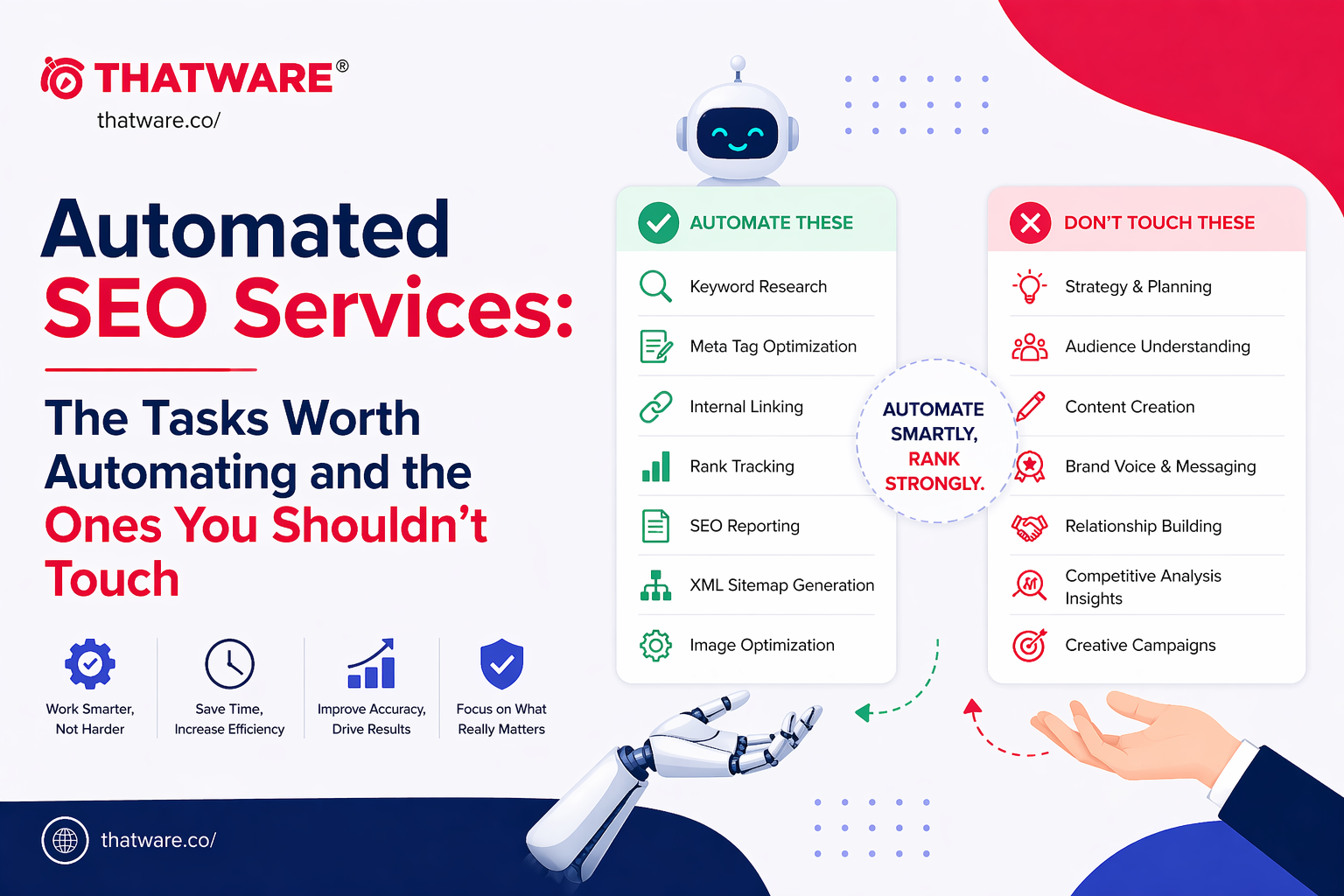
Technical SEO audits are an obvious fit for automation. Crawling a large site to surface broken links, duplicate content, slow pages, redirect chains, missing meta tags – these are repetitive, pattern-matching tasks that tools do faster and more thoroughly than humans. Running these regularly and automatically means you catch issues early instead of discovering them when rankings have already dropped.
Rank tracking and performance monitoring are similar. Watching keyword positions across dozens or hundreds of target terms, flagging significant changes, correlating traffic shifts with technical or content changes – automation handles this cleanly and lets human attention focus on interpreting the data rather than collecting it.
Competitor monitoring is another strong use case. Automated alerts when competitors publish new content, acquire significant backlinks, or change their on-page structure can surface strategic insights that would be easy to miss if you were doing it manually.
Related storyWhen Intelligence Moves Closer to the Edge: The Quiet Battle Between Edge AI and Cloud AI
Keyword research tooling has gotten genuinely good. Clustering large keyword sets by semantic similarity, identifying content gap opportunities, surfacing questions from forums and search suggestions – these tasks benefit enormously from automation because of the sheer data volume involved.
Automated seo services that focus on these operational and analytical layers can create significant efficiency gains without sacrificing quality. The key word there is “operational.” Automation works best when the task is well-defined, pattern-based, and doesn’t require contextual judgment.
Where Automation Gets You Into Trouble
Here’s where it gets more complicated.
Content creation at scale is the most significant danger zone. There’s a meaningful difference between using AI to assist content creation – helping with outlines, research synthesis, identifying gaps – and using it to *replace* content creation at volume. The first adds efficiency without sacrificing quality. The second often produces content that is technically passable but genuinely thin on value.
The problem isn’t that automated content is obviously bad. Quite often it isn’t. The problem is that it tends to be *generic* – covering the most predictable angles of a topic without bringing the kind of specific knowledge, experience-based insight, or genuine depth that makes content worth reading and worth citing. As AI search systems get better at recognizing that difference, mass-automated content is becoming a liability, not just a neutral tool.
Related storyWhen You Don’t Need to Be “Present” Anymore: The Rise of Digital Clones in Modern Identity
Link building is another area where automation promises more than it delivers. Automated outreach at scale, bulk link acquisition through networks, AI-generated link bait – these shortcuts have a pattern of working briefly and then becoming Google penalties waiting to happen. Quality backlinks still require quality relationships and quality content. Automating those things away tends to produce exactly the kind of signals that eventually trigger algorithmic or manual actions.
Schema markup generation is a nuanced one. Automation can help generate structured data, but incorrect or over-broad schema implementation can actively hurt you. This is an area where automated output needs careful human review.
The AI-Assisted Middle Ground
There’s a category between “fully automated” and “fully manual” that deserves more attention than it gets: AI-assisted workflows where humans make the final calls but AI dramatically accelerates the process.
This is arguably where ai seo services deliver their best value. Using AI to draft content outlines that a human writer then fleshes out with genuine expertise. Using machine learning to prioritize which technical SEO issues actually need attention versus which can wait. Using natural language processing to analyze competitor content and surface angle opportunities that human strategists can act on.
The common thread in these applications is that AI is handling the pattern-matching, data processing, and first-pass generation – while humans are providing judgment, context, and the kind of authentic knowledge that AI genuinely can’t replicate.
That’s a useful frame for evaluating any SEO automation pitch: is this tool replacing a task that requires judgment, or is it accelerating a task that’s mostly pattern-matching? The former is risky. The latter is worth taking seriously.
Questions to Ask Before Automating Anything
Before automating any SEO task, it’s worth asking a few questions that the tool vendors will rarely bring up themselves.
What happens to quality at scale? Some tasks maintain quality whether you do 10 or 10,000 of them. Others – particularly content creation and link outreach – degrade considerably at scale. Understanding that threshold matters.
What’s the recovery time if it goes wrong? Technical automation errors are usually recoverable quickly. A large-scale automated content or link strategy gone wrong can take months or years to undo. The asymmetry of risk matters.
Is the output inspectable? Good automation tools let you audit what they’re doing. If you can’t easily review the output of an automated process, you’re essentially trusting it blindly – which is fine for low-stakes tasks and unacceptable for high-stakes ones.
Does it produce signals Google is trying to devalue? This one’s uncomfortable but necessary. Google has been quite explicit that it’s trying to reward genuinely helpful content and penalize mass-produced signals. If an automation tool is producing exactly the kind of signals Google is working to devalue, the short-term efficiency gains are probably not worth the long-term exposure.
The brands that get the most from SEO automation are usually the ones who think carefully about where it belongs – not the ones who automate everything they can and hope for the best.